Videos of Mothers Taking Sexy Videos With Baby's in Back Ground
Take a question? Transport information technology to u.s.a. in a straight message on Facebook, Twitter or Instagram.
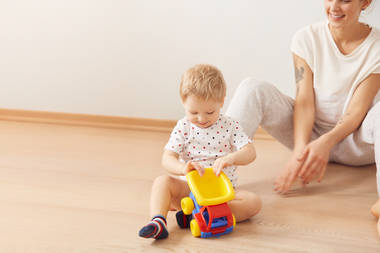
Interested in what other parents are asking? Read on, and remember that we're all doing our best to effigy things out. There's no "correct" answers correct now—and it'south all about trial and mistake and finding what works for your family. Use these Q&As to help inform your own parenting decisions, while we all cope with coronavirus and the changes it'south meant for our families and communities.
Volition my child be behind in their social skills due to social distancing?
Q: Rules about staying home and social distancing kicked in just as my toddler turned ii and was almost to kickoff a local preschool program. This feels like the worst possible time for u.s.a. to be stuck at dwelling house—he'due south full of energy and fascinated by his peers. I'g worried that he is going to exist behind in his social skills once we are (finally) back to regular life and his pre-k program re-opens.
A: Having a take a chance to learn and practice social skills with peers—sharing, plough-taking, resolving conflict, and more—is definitely important for young children. The more experience they have interacting with peers, the more they acquire about how to get along with others.
But—developing social skills is a procedure that takes time and feel. Your son will learn to have turns and share over a number of years, every bit he practices handling these challenges over and over. Putting a break on peer interactions for a few months will not put him behind. In the meantime, you can coach him to practise new social-emotional skills. For instance, opportunities to share and accept turns happen naturally throughout the day. Teach simple language that will be useful later in peer play: My turn, Desire to play?, Tin I share? Y'all tin can besides role model self-regulation and other social skills: I am so frustrated. I retrieve I'll have a deep breath to calm myself downwards. Share children'due south books that accost social-emotional themes, like the ones on Nix TO Three's booklist. Build on these stories in pretend play to assistance him practice the linguistic communication and skills to handle peer situations when he does come across them.
Finally, while information technology's not the same equally real-life playtime, your toddler may enjoy video-chat with other children his historic period. This gives him a take a chance to practice simple greetings and questions with a friend. You tin back up these interactions by suggesting songs to sing together or playing the toddler game of "I'll show you my toy, now you evidence me yours." They can even play with cars or other toys "together," each on their side of the screen.
The brusque answer is: The kids volition be alright. While these days are long and the weeks ahead are unsure, your toddler is learning and practicing social skills through everyday routines with yous. When the fourth dimension comes to release them into the world of their peers, they'll be ready.
How do I encourage independent play?
Q: I know it would be platonic if we could spend our time at abode due to coronavirus playing with our children all the time, only information technology's just not possible. How exercise I get my niggling ones to play on their own for a little while when I need do other things (work/fix food/etc.)?
A: This is a great question and something that almost every parent is wondering most correct now! Let'due south starting time with what to await when information technology comes to attention bridge in the early years. Spoiler: It's not long. By one yr, children have an attention span of 1-3 minutes. By age ii, toddlers' attention span has grown to about v-six minutes. Three-year-olds can nourish for up to eight minutes and 4s up to near 10 minutes.
Then—while nosotros tin help children engage in independent play, it'southward important to hold the right expectations most how long young children can focus. The role of a parent in these early on years is to support a child'due south growing ability to extend their attention.
How to introduce more independent play? Start, get together some engaging toys or materials for your child to explore. Objects that can be used many different ways during play often work better than a toy that only does one thing. (For example, children can quickly tire of a toy where they press a button and it plays a song.) Keep your selections age-appropriate—some items to consider are blocks, art materials (crayons, paper), housekeeping props and dolls/stuffed animals, assurance and baskets, and interesting "stuff" similar egg cartons, masking tape, paper towel and toilet paper tubes, pinecones, shells, and more than. Toddlers who are enjoying pretend play might similar a pad, pens, clipboard, and other "work" items. (My friend gave her toddler a shoebox with 'buttons' she had fatigued with mark. He happily tapped on this "keyboard" while she typed on hers.)
Introduce the play items and let your child take the lead. Enquire what you should exercise or how your child would similar to play. Expect to see how your child creates opportunities to pretend, combine, sort, match, and construct. As your child becomes engaged in play, stage yourself out. Accept less of an active role and sit down dorsum and sentinel. If your child checks in, annotate on their play, "I saw you line all the pinecones up on the floor. Information technology was a long line."
Then move to your ain action. Stay close past because your child volition loop back to you when they want to bank check in (offering a hug/buss), want your attending (comment on their play), or have run out of ideas of what to exercise. In that case, you may desire to offer an boosted prop, object or material to add together to their exploration. For instance, y'all might offer dried pasta for them to stir, pour, and transfer using plastic containers and spoons. If they aren't certain how to continue in their play, you can likewise propose 2 choices: "Hmm, do you recollect your babe needs a bath or wants to swallow pretend water ice foam at present?" Strategies like these aid children extend their attending by returning to the play again with a new focus.
Over fourth dimension, children volition need less back up with gratis play—and, somewhen, we'll all find a "new normal" in these daily routines.
How should I address screen time?
Q: What should we do nigh screen time rules while we're sheltering-in-place? I've got to work to exercise (and sometimes I just demand a break). Equally a event, my toddlers are on screens more than than usual.
A: I reached out to my co-authors of Cipher TO 3'due south Screen Sense materials—Rachel Barr, PhD from Georgetown University and Elisabeth McClure, PhD of the LEGO Foundation—about your question. Given the many stressors and demands that parents are facing right now, hither are some guiding thoughts on managing screen time during periods of work-at-home and shelter-in-place:
- Encourage video conversation. Video chat helps young children—even babies—recall and build relationships with family members.
- Choose educational programming. These are stressful times. Don't experience bad about using screens more than usual. Cull age-appropriate, educational programs (similar those on PBS) if you opt to allow extra screen time.
- When you can, watch programs or play video games/apps with your kid. Talk about what's happening on screen. Afterward, use real-world playtime to extend the learning from screens—counting, matching, pretend play, and more.
- Make certain children have access to a balanced "activity diet." While they may be engaged with screens more than than usual, information technology'south still important for toddlers to take a mix of activities across the day, including gratis play, story/book time, art activities, and agile play.
How can I manage screen time for two children of different ages and needs?
Q: My three-year-old is getting more screen time than usual and every bit a outcome, my 12-month-onetime is ofttimes in the room and getting more than TV in the groundwork too. Nosotros try to separate them when my daughter is watching only it's not always successful (or possible!). Is this something nosotros should be worried almost?
A: These are unusual times and near (if not all) of our family rules and routines are a petty out of whack. The research is pretty clear that groundwork media tin can interrupt the play of young children, decrease parent-child interactions, and interfere with learning. But nosotros all live in reality here. Sometimes media fourth dimension is parents' just chance to focus on other responsibilities.
The commencement thing to call back is that sheltering-in-place is not expected to be a long-term situation. The negative child outcomes we encounter for background TV exposure is in the context of long-term, all-encompassing exposure, not the short-term weeks or months that we're experiencing now. Secondly, you are dealing with the reality of having two children. When I had a similar business concern recently, my husband responded, "What do you want me to do—put Number 2 in a box?" We do non recommend boxing our younger sibs! Only if it's possible to prepare trivial ones up with some serenity play well-nigh united states of america (while our older one has screen time separately), that's ideal. Allowing your older sibling to watch on a tablet limits your younger kid'south access to the screen too.
Finally, proceed in heed this dilemma is one that every parent of two or more than children deals with at some point. Younger children tend to do activities earlier than their older siblings did, just past virtue of being in that location. So, try to choose a screen feel that is high quality, educational content (cheque out PBS' offerings) and also select programs that appeal to a wide range of ages—such every bit Blue'due south Clues, Kipper, Curious George, and Daniel Tiger's Neighborhood.
We're all figuring out how to balance our dissimilar roles and demands right now, including our most of import one—mom or dad. Y'all're request all the right questions and the answer is really about balance and making sure everyone is getting their needs met (including grown-ups!).
For babies under 6 months of historic period, what are the long-term furnishings of social distancing?
Q: As a home company, I am asked by parents who accept babies under vi months of age what the long-term effects of social distancing are. Will babies' social emotional evolution exist affected with reduced face to face interactions? Will their ability to interact with people after isolation is lifted be altered or impaired?
A: Families hopefully accept been able to stay together through the stay-at-domicile and social distancing orders. This ways young children will exist able to stay close to their principal caregiver. If this happens, and those caregivers are able to provide a secure base, with attuned and responsive care, there should not be a long term touch to social distancing.
However, for some of our families, they have fabricated the decision to stay away from their kid due to their essential work and their risk of exposure to COVID-19. For these families, we can offering guidance on staying continued to their child even though they physically are apart. Nosotros know from our military families and their frequent deployments away from dwelling house that babies will be fine if caregivers are taking steps to keep the connection strong. We accept developed some guidance to assistance back up families think well-nigh steps they tin can take if they must be separated from their child.
Every bit a habitation visitor, yous also know we are concerned about those families who are having difficulty creating a prophylactic and secure identify for their child. We know early child education and habitation visiting services help to promote positive parenting. What happens to these at risk families when those visits end, or when there is no respite provided through early on childhood educational activity services? Parents who feel socially isolated and stressed may not be able to provide the needed secure base of operations for their child. This is a concern. We encourage professionals similar yourself to stay in contact with your families through telehealth. Aid families recollect out of the box well-nigh getting the support they need, peculiarly those protective and promotive factors usually available. Can families join virtual parent coffee hours to get some needed support? Can you encourage using smart phone technology to have grandfather or Auntie read for 10 minutes to a toddler to give that single parent a short break? Can we make sure at that place is no nutrient insecurity that tin can heighten family unit's stress? The work you do as a dwelling visitor is then of import in protecting our most vulnerable families. For this, we say thank you for your work; yous are making a difference.
How tin I work with my partner to manage challenging behavior in my older toddler?
Q: I always knew my married man and I aren't quite on the same page when it comes to how to react to problematic behavior from our older toddler. But I'grand recognizing we need some all-encompassing help in getting us all on the same page (like some parent coaching). Another way of phrasing it: Aid! So far this week my kid has drawn on the wall, deliberately spilled his milk, and thrown things. Are at that place any resources you tin point us to that tin assistance us figure out a plan that may piece of work?
A: Staying at home probably emphasizes the different approaches you and your husband have in dealing with your kid'south challenging beliefs. We recommend starting by taking a deep breath, and know that you volition become through this!
In one case you know yous are equally calm as you can be (because our electric current circumstance), consider things from your toddler'due south point of view. Things right now are then confusing, and a flake overwhelming for adults; imagine a young kid trying to make sense of this! Children tin can pick upward on your tension, your worry. However, they don't accept the power to process it. Instead, they show yous their worry and business concern past cartoon negative attention to themselves.
The role of the brain that allows grownups to stop and recollect almost the issue of our actions, isn't fully developed yet in a toddler. They are impulsive and total of emotions. Throwing things, cartoon on walls, going back to earlier behaviors—these are all ways our young children tell us, "things are so different– I don't feel condom right now! I need you to notice me." Take a look at our Positive Parenting resources, it may help you and your hubby to find mutual ground in your arroyo to parenting your toddler. For parenting coaches in your area, you can contact your country'due south brotherhood for infant mental health for practitioners in your area, or your country'due south 211 information service. Your child care provider may also have suggestions for parenting classes, or your local child care resource and referral agency.
How can parents cope with potential exposure to COVID-19 while all the same being present for their family?
Q: I am a Home Company and I am supporting a family who is transitioning back to work later on their baby was born 2 months ago. They are both front line workers and are wondering how to cope with their potential exposure to COVID-19 and all of the stress of that, whilst all the same being present for their child.
A: What a tough time for both of these parents. In terms of limiting the baby's potential exposure to coronavirus, function of their back-to-work preparations should exist a consultation with their child'south wellness care provider to discuss infection control protocols and what symptoms to monitor in young babies. Their other, every bit of import question is how to remain present and connected with their babe during such an intensely stressful fourth dimension—particularly given their front-line roles. Here are some ideas they might desire to try, which can aid to reduce their own (justified!) anxieties just also provide their new family with a soothing time for connection:
-
Create routines that nurture the whole family. We often talk nearly how bedtime and mealtime routines assistance children feel prophylactic, organized, and secure. But routines help united states experience that way too! Partner with parents on developing a "home from work" routine that they might want to try – perhaps sharing a story with their trivial one, or playtime on the flooring to ease back into family life after work. Bedtime routines, with lights dimmed and soft music, are too a great opportunity to connect and decompress.
-
Limit news media. While many of united states experience unspoken pressure level to check in with news constantly, the truth is that reading the news tin frequently spark additional anxieties or a sense of powerlessness. Consider limiting news to one time or twice a twenty-four hour period simply, and non close to bedtime. Also, keep the television off when baby is nowadays (groundwork goggle box tin reduce the quality of parent-child interactions and interfere with children's learning). Plus, even very young children pick upward on the tension we feel from watching or reading tough news.
-
Play "find five things." This is a mindfulness action that helps us focus on the nowadays moment. Ask parents to expect—actually look—at their baby and find five special details about him or her: the fold of her chubby baby belly, the curve of her ear, the shape of her big toe. This moment of dedicated attention will delight baby and help footing parents in this shared relationship.
-
Copy babe. This activity invites parents connect with their baby through "back and forth" interactions. When baby is calm and happy, inquire a parent to sit with her facing them. Ask them to break and brand heart contact. As she blinks, sticks her tongue out, gazes, or moves her artillery, parents tin gently imitate those gestures and movements. Encourage them to continue this "copy me" game until baby has tired of information technology—looks away or starts to get fussy. These serenity moments of being in melody with their baby tin can be soothing to both parents and their piddling i.
-
Share music. Music is comforting for many reasons, i of them being the consistent, predictable pattern of rhythm and lyrics. Encourage parents to hold baby and share their favorite songs—from the radio, from their childhood, from their home country. Coming together with affect and vocalism is a bang-up way of reducing stress and increasing a sense of family connexion.
-
Have intendance of themselves. I almost didn't suggest self-care in my response to this question—here we have two new parents, during shelter-in-identify with distancing restrictions, and returning to total-time, front-line piece of work. Merely the truth is that self-care is more of import than ever. We're not talking a day at the spa, which is unrealistic for most new parents and impossible right now. But co-parents would benefit from talking most what they demand to feel centered and calm. Is information technology 10 minutes alone before bed? Is information technology taking a long, hot, uninterrupted-by-baby shower? Is information technology going for a run each morning? Negotiating how they will each treat themselves, for each other, and how they will come together to nurture their family, is an important office of the transition to parenthood—pandemic or non.
Is information technology condom to leave home? What will be okay to accept my toddler to and what isn't?
Q: As nosotros recall most opening up our country again, I find myself worrying. Is it safe to leave home? What will be okay to take my toddler to and what isn't? How will I know?
A: As we imagine returning to life every bit normal with errands, play dates, and visits with family, parents across the country share similar worries near their children'due south health and safety. Here are a few things to keep in mind:
- You're right to experience worried and anxious. Try non to exist hard on yourself. These are uncertain times, and it's perfectly normal to take these feelings. For example, you might experience pressure level from loved ones to bring baby for "just a quick visit" once stay-at-domicile orders showtime to lift. Information technology'south okay to say no to something that doesn't feel safe to yous.
- Make informed decisions. Stay informed nearly current health recommendations from trusted sources like your local and state government and the Centers for Affliction Command and Prevention. You tin also get to your child's health care provider with questions. They can guide your decision-making with science-based information.
- Take intendance to avoid scary talk around picayune ones. While you may be concerned virtually the render to child care, dealing with crowds at the park, or visiting family, try not to share those worries in forepart of your children. Although they might be good at hiding information technology, children are always listening to us. Overhearing adult conversations virtually COVID-19 can brand things harder on young children. When they hear words they don't sympathise or sense their parents' worries, they feel worried too. Make certain grown-up conversations well-nigh COVID-19 are kept individual. Answer your child'south questions directly and as simply as possible, based on their developmental historic period.
- Share new rules and practices without communicating fear. Information technology's possible that as communities re-open up, there may be new practices nosotros utilize to keep everyone healthy. For case, nosotros may demand to teach children new means of greeting friends without giving hugs, continue the accent on hand-washing, or teach safe ways of coughing and sneezing. Exist matter-of-fact nigh these new rules, exist a adept role model yourself, and stay patient. Young children will need a lot of repetition and do earlier they recall these rules consistently.
- Yous're important as well. It's easy to focus on everything but ourselves when life gets crazy. Merely eventually the stress we're nether may get-go to impact how we intendance for our kids. That's why it'south important to find a little time each 24-hour interval to practice something that feels good—a workout, a volume, or fifty-fifty binging a bully show afterwards the kids are in bed. When y'all experience calmer, your whole family feels calmer. But information technology's also possible that feelings of depression or anxiety are starting to get in the way of your daily life. If you're struggling, reach out to your health care provider for help. You lot deserve good health and a sense of well-being.
We're all a little unsure about what it will mean to re-open our communities. Feeling anxious about taking your child to a playground, traveling, or going to public places is a normal reaction to COVID-xix. Making thoughtful decisions—using the best information you have access to—gives y'all the opportunity to make choices that encounter your family unit's needs. That'southward the power of positive parenting.
Looking for more information? Visit zerotothree.org/coronavirus for our latest resources and updates for families.
How can I help my 3 yr old son handle an extended separation during my delivery of our 2d child equally the hospital does not let visitors?
Q: I am expecting my 2nd child in October and have been looking for tips to help my 3 year old son handle an extended separation during my scheduled C-section. We will be apart for approximately 3 days and he will stay with his grandparents. The hospital does non allow visitors due to Covid. Practice I introduce him to his baby sister via video conversation while I'm in the hospital? Whatsoever suggestions would be very much appreciated!
A: Congratulations on your upcoming new addition! It sounds as though you are grappling with two different questions – starting time, how to manage the separation from your toddler while yous're in the hospital and 2d, how to introduce him to his new baby sister (!!). First things first—managing the separation. You'll desire to start by talking with your son, starting about a month before your due appointment, about what will happen when his new sister joins the family. Explicate, in a thing-of-fact way, how you will leave for a few days and come back with his sister. Be sure to reassure him about where he will go, who will care for him, and what he'll do while you're gone. Watch videos that evidence the inside of the hospital and the nursery (if they're available) and then he volition know and tin can picture where yous are. Let him that you volition be okay, that you love him, and that you'll talk with him on video chat while you lot're away (if that's the programme). Tell this story regularly—a few times a week—in the weeks before delivery. Young children demand to hear the same information many times before they can understand and remember.
Some families make an actual bootleg book to help their child understand what's going to happen – you can use pictures of your kid, his grandparents and their house, and pictures of you and the hospital. On each page, glue a photo and include a judgement or 2 explaining what volition happen during this menses while y'all're abroad. Sharing this homemade book in the month before you lot deliver is another fashion of preparing your son. If you'd prefer to pull a story off the shelf, find corking children's books on welcoming a sibling in this Nil TO THREE booklist.
To help your son visualize how long you lot will be away during your commitment and recovery, you lot might want to create a concrete mode for your son to mark the days. For example, you might have three paper numberless – each labelled "1", "ii", and "three" for the iii days that you'll be away. Each morning, he can open a bag and notice a drawing, photo or sticker from you. When he opens the concluding purse, he'll know that's the day you come up dwelling. Or y'all tin can create a sticker nautical chart with iii boxes – each twenty-four hours you are away, he can put a sticker in a box and on the third box he'll know it's "coming home day."
As far as using videochat to innovate him to his baby sister, I would say aye! If he's non already familiar with videochat technology, I would starting time using it with him now for conversations with grandparents or other relatives. By the time his sister arrives, he'll be an expert and volition certainly understand that the babe he sees on the screen is "his." Videochat is as well a great way to requite him a sneak peek of his sis and help him begin to feel connected to your family unit's littlest (but loudest) new fellow member.
Source: https://www.zerotothree.org/resources/3299-baby-talks-parent-coronavirus-questions-answered

Enregistrer un commentaire for "Videos of Mothers Taking Sexy Videos With Baby's in Back Ground"